Analysis of Swiss Civil Defense Model for Community Preparedness
Key Swiss Principles Applicable to Your Framework:
1. Total Defense Concept
- Switzerland integrates military, civil, economic, and information defense
- Your legislation mirrors this in Part 1, Section 3(a) with “total defence principles”
- Creates redundancy where civilian and military capabilities complement each other
2. Universal Obligation with Alternatives
- Swiss model requires service but offers multiple pathways (military, civil service, civil protection)
- Your Part 3 effectively mirrors this with National Civil Defence Corps, ADF service, or alternative civilian service
- Ensures broad population engagement while respecting individual circumstances
3. Local-Regional-Federal Integration
- Swiss civil defense operates at commune, canton, and federal levels
- Your Part 4 (Local Civil Defence Units) and Part 7 (Administration) create similar tiered structure
- Enables rapid local response while maintaining national coordination
4. Dual-Use Infrastructure Planning
- Switzerland mandates shelters and dual-purpose facilities
- Your Part 5, Section 13 incorporates this principle
- Creates resilient infrastructure serving both peacetime and emergency needs
Frameworks for Community Resilience Against Various Threats
1. All-Hazards Approach

2. Community Resilience Framework
- Preparedness : Regular training cycles (your Section 10 annual requirements)
- Response : Local units as first responders with regional backup
- Recovery : Community-led rebuilding with federal resource coordination
- Adaptation : Continuous learning and capability improvement
3. Social Cohesion Elements
- Universal service creates shared experience across social divisions
- Your Section 8(2) emphasizing equality regardless of “gender, social status, or economic position”
- Local units build neighborhood networks and mutual trust
- Regular exercises create practiced cooperation habits
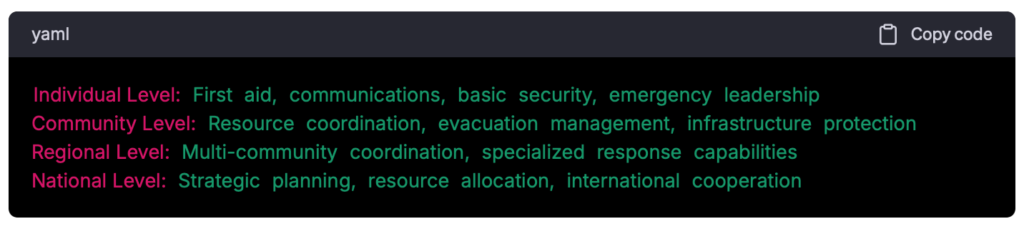
4. Skills Development Matrix
Strengths of Your Legislative Framework:
- Constitutional grounding provides legal certainty
- Flexibility in service options accommodates diverse population
- Integration with existing services prevents bureaucratic duplication
- Local focus builds community ownership
- Federal oversight ensures national standards
This framework could significantly enhance Australia’s resilience by creating a trained, distributed capability that strengthens communities while supporting national defense objectives.